Varun V
Partner
Date
Read time
Read time

A B2B software company had grown deal volume for 4 consecutive quarters without moving closed revenue. With a 14 week engagement, we re-built the work between qualification and signature, removing 12 days of internal wait for an average enterprise deal
At a glance
Internal wait per enterprise deal | 19 days → 7 days |
|---|---|
Proposal turnaround | 6.2 days → 2.4 days |
Median sales cycle | 128 days → 113 days |
Operating cost removed, annualised | $531,000 – $639,000 |
The Situation
The client is a B2B Software and Services company with $165Mn in annual revenue. Its GTM org has around 67 people: 45 carrying quota, 12 SDRs, 6 Sales engineers and a 4 person deal desk.
The company closes ~360 new and expansions deals a year at an ACV of $145K
Reviewing 640 closed and lost deals across eight quarters located the gap. The avg enterprise deal spent 19 days, waiting for internal action. Which was spread across proposal generation, pricing approval, security review, and the re-assembly of account context.
Nearly 68% of deals had context that was re-built three separate times: Once by the rep, one by the sales engineer and finally once by the proposal author.
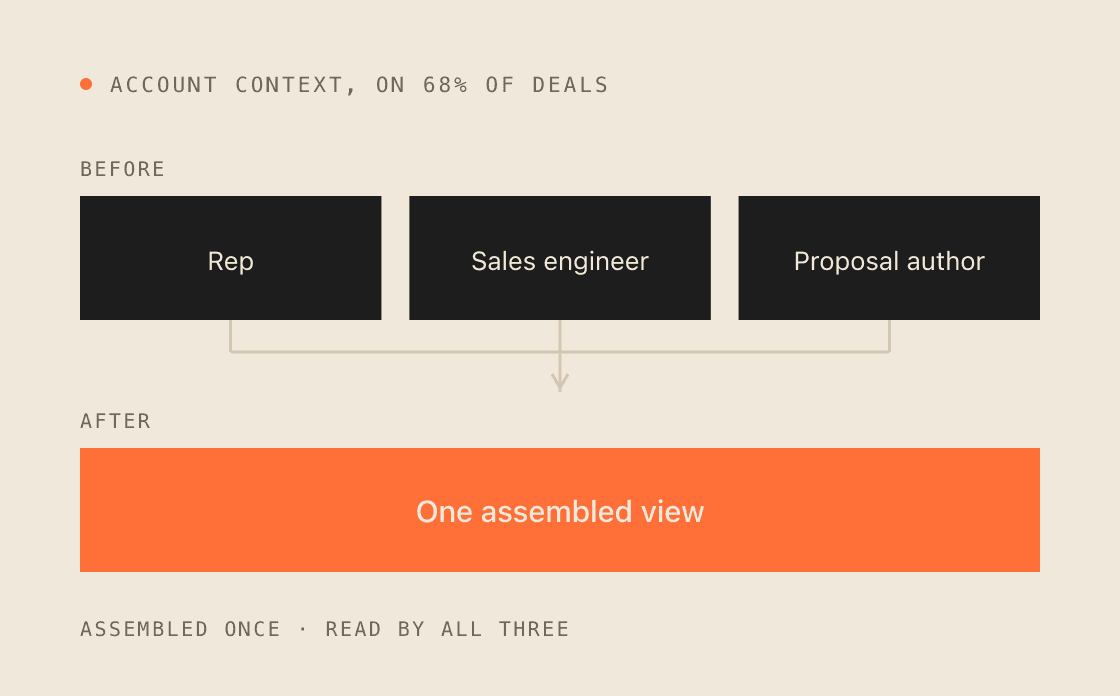
Three assemblies became one.
Contact enrichment had failed about 8 months earlier, leaving ~28% of contacts in active sequences at employers they had already left.
In addition, the company previously had purchased two general purpose AI writing tools. Both were abandoned very soon for lack of adoption, reliability and producing generic outputs on a technical sale.
Neither could reference the live pricing and product corpus.
Our Approach
About 5 weeks of diagnosis where we got on multiple calls and worked alongside three enterprise reps. We worked closed with the deal desk through a full quarter end, recording any and all exceptions.
We combined this with snippets we extracted from interviews and drew out an extensive information flow diagram that replicated how the revenue department functioned.
Following this, we went about building for ~9 weeks, laying the foundation for ‘system of action” agents that worked with existing data tooling.
The operator layer connected with Salesforce, Gong, Slack, CPQ software and the contract system, surfacing actions that required human intervention. Four field were added to the CRM schema.
Five Workstreams we delivered
Context : An assembled view of every account, which is grounded in the CRM records, mail history, call records, and buyer activity. This is designed to be read by the rep, the sales engineer and when generating the proposal.
Outbound : Drafted outreach that the rep reviews and sends. Voice profiles are built for every rep from their own sent email + call recordings rather than a team template.
While the sales playbook is followed rigorously for what not to do, we took certain liberties while ensuring that any and all improvements to sound human-like stayed bounded.
Proposal: Proposals were drafted against the live product and pricing corpus. Which means every factual assertion was linked to the source document and the version that produced it.
Deal Desk : Each person's open deal position was tracked in the approval chain, and triggered the automatic next steps. Relevant escalations were done once the internal service level was breached.
Data : CRM records were continuously refreshed , along with validating contacts. We followed a waterfall enrichment system to ensure data coverage and bring down enrichment costs.
This was combined with relevant intent signals and look alike audiences which meant the outbound motion had a steady stream of qualified prospects to reach out to, with maximum resonance.
About 70 percent of the system's operations were deterministic. Mostly around queries, comparison and branch logic. Language models were applied in instances where judgement is required , principally in interpreting the state of a relationship and drafting.
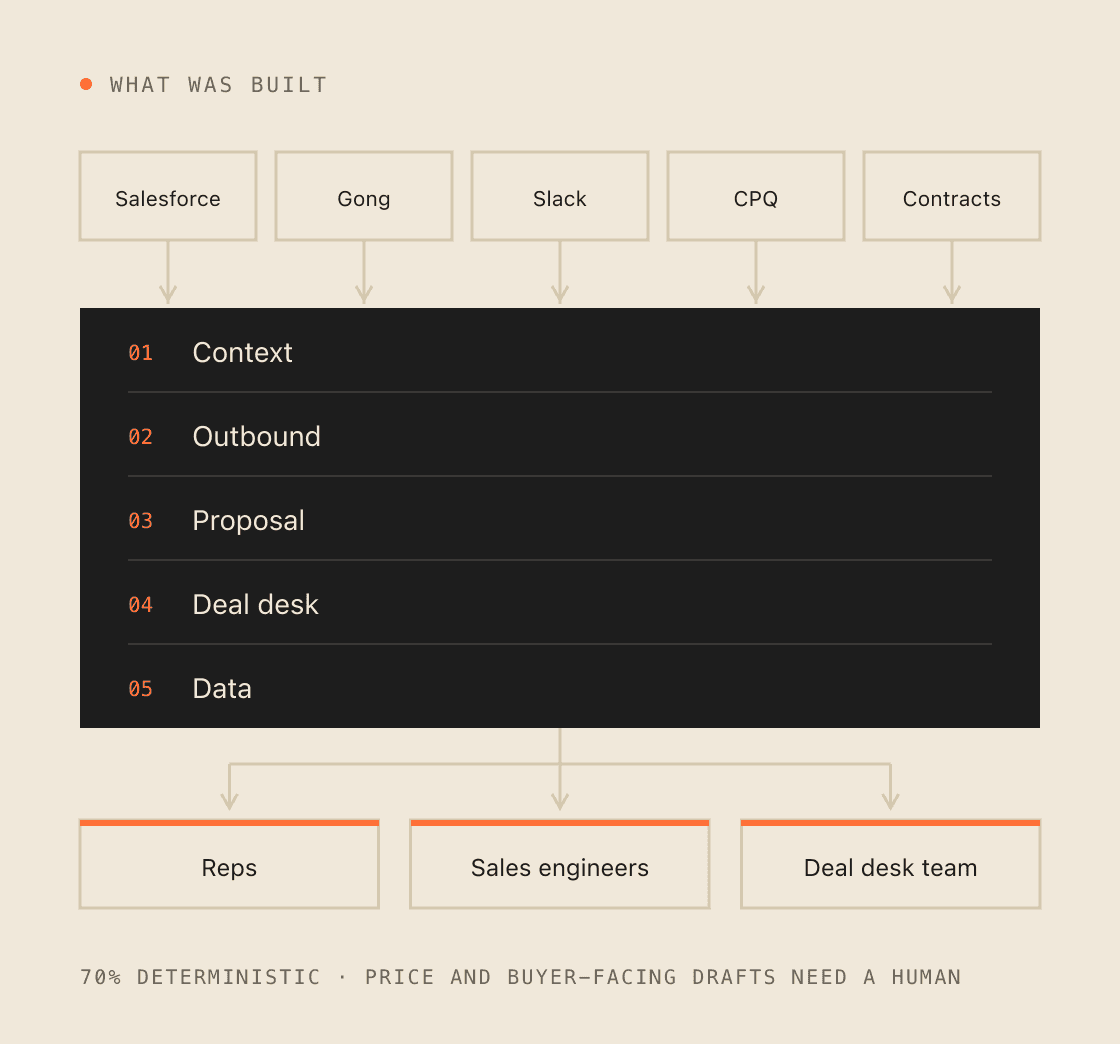
What was built, what feeds it, who uses it.
Governance
A couple of fundamental rules that were set at go live and remained unchanged throughout:
Pricing, discounts and contract terms need human approval in all cases.
No draft reaches a buyer until and unless a rep sends it.
Every action is recorded with the rule or model that produced it, the inputs and the approver where one was necessary.
Writes to a system of record are reversible for 30 days.
The Results
Rollout was phased by pods. 30 reps received the system by the end of month 3. About 15 received it at the beginning of month 5.
Measure | Before | After |
|---|---|---|
Internal wait per enterprise deal | 19.0 days | 7.0 days |
Proposal turnaround | 6.2 days | 2.4 days |
Median sales cycle | 128 days | 113 days |
Account context assembled per deal | 3 times | once |
Stale contacts in active sequences | 28% | 2.6% |
Deal desk exceptions cleared without a person | 0% | 61% |
Draft revision before sending | 58% of characters | 21% |
Win rate on qualified pipeline | 22.0% | 24.1% |
Drafting the proposal and pricing approval accounted for 7.5 days of the 12 removed.
Buyer side elapsed time did not change much and the majority of gains were seen in cycle reduction of the largest enterprise deals, where most of the internal wait was concentrated.
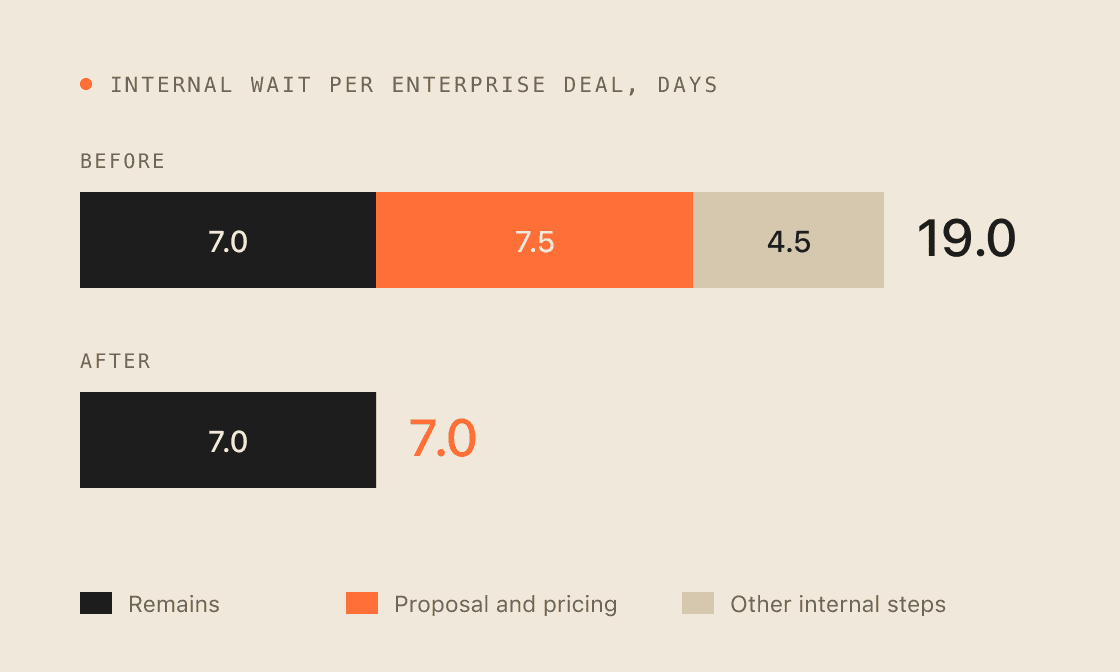
19 days to 7, and where the 12 came from.
40 of 45 reps were using the system weekly by month 5. Five did not adopt it. All five are top decile performers with established research routines and methods of operation.
The Economics
Operating cost removed: $531,000 to $639,000 a year
Each line was reconciled by the client's finance team against the approved headcount plan and accounts payable.
Annualised | |
|---|---|
Deal desk requisitions cancelled, 2 of 2 approved | $216,000 – $264,000 |
Sales development requisitions deferred, 2 of 3 approved | $168,000 – $204,000 |
Contract proposal writing discontinued | $62,000 – $86,000 |
Data vendor consolidation, two contracts | $85,000 |
Total | $531,000 – $639,000 |
We did not eliminate any positions.
First year figures are lower than the annualised total as savings take effect between months 3 and 9.
Cost to run: $160,000 to $180,000 a year
Includes Infrastructure and model usage, retained engineering for rule changes and corpus maintenance,
In addition it also includes ¼ the time of a FTE who is assigned to own the system.
Net of the cost to run it, the operating saving returns $351,000 to $479,000 a year.
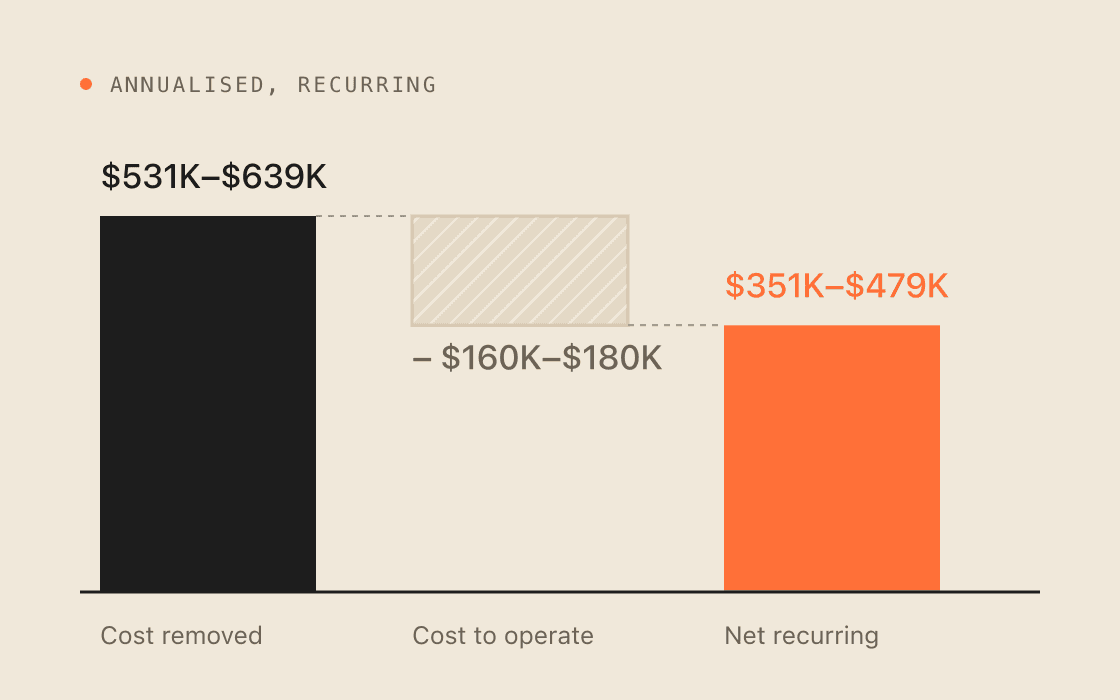
Removed, less cost to operate, net.
Revenue effect: approximately $1.4 million of gross profit a year
Additional wins at 2.1 points on 1,636 qualified opportunities | 34 deals |
|---|---|
Additional bookings at $145,000 average value | $5.0M |
After a 40 percent attribution discount | $2.0M |
Gross profit at the client's 68 percent blended margin | $1.4M |
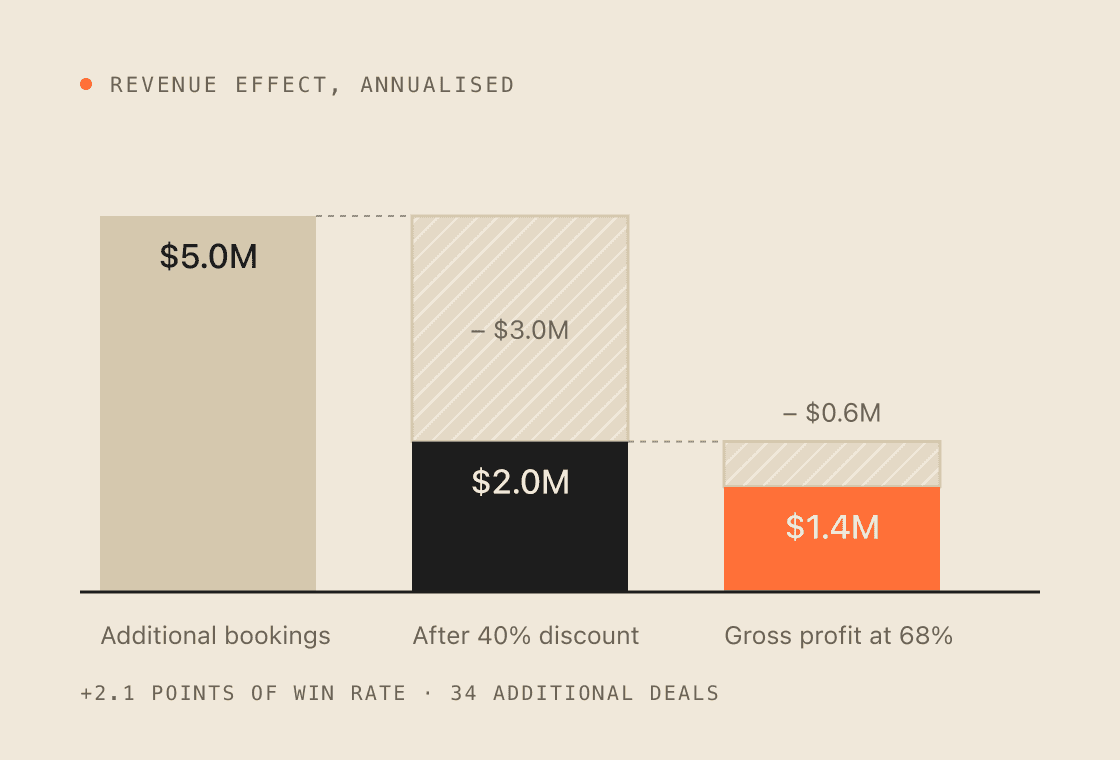
$5.0M becomes $1.4M, and why.
The goal is to be conservative with numbers.
The discount is applied for a couple of reasons.
One single quarter and 409 opportunities cannot effectively separate a 2.1 base point movement from normal variation
List price increase in month eight affect both the deployed and the control group ( as in the people who received access to the system later)
What is not included :
Win rate is directional. Atleast 4 quarters of post rollout data are required before it can be treated as established.
Cycle reduction is entirely internal and a good chunk of the onus lies with the prospect’s decision making process. While we can make said activities more efficient, the system has no control with delays that happen with decision making.
Where this Applies
Engagement suits orgs with more than ~15 quota carriers all the way upto hundreds. Enforced CRM stage definitions, current product and pricing documentation are necessary.
Playbooks that illustrate deal progressions, additional defined modules for cross sell and upsell along with defined rules for commission disbursement.
Deal forecasting can be predicted with enough historical data. Combine product usage, client interaction frequency, company size and total number of touchpoints , you can arrive at a baseline modeling of predictive close % that can support AE intuition.
Encoding tribal rules, around how the AE operates, deal desk approved discounts or exceptions proposal and contract drafting/ pricing can be turned into systematic rules. The AI can be used to bubble up suggestions, as to when the rules feel applicable.
Read also