Varun V
Partner
Date
Read time
Read time

A LMM PE firm needed consolidated portco numbers by the tenth of each month. In addition to delays, the team had to spend a lot of time cleaning and normalising the data.
The team was drowning in repeated back and forth with portco companies in follow-ups, form fill outs and often questioned the accuracy of reported numbers.
A 12 week engagement rebuilt AP, reconciliation and close across 9 portcos without replacing existing systems of record, accounting software etc.
In fact the goal was to give the CFO and controller all the info necessary to make financial projections, and write memos to LPs and the IC, fully trusting the veracity of the data.
At a glance
Before | After | |
|---|---|---|
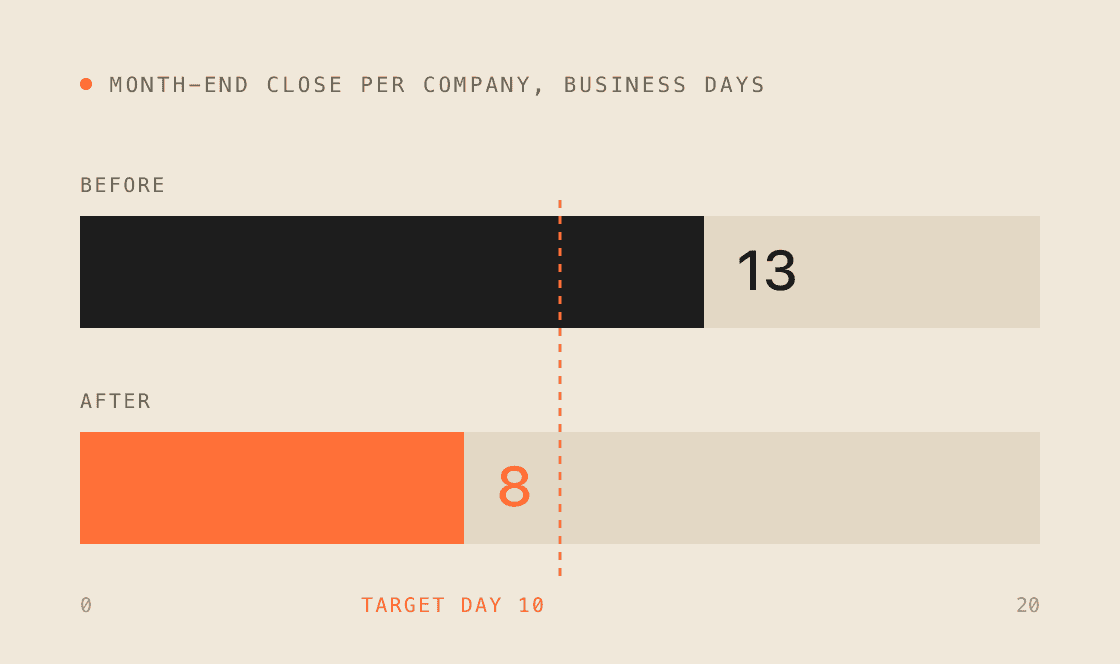
Close duration per company | 13 days | 8 days |
Consolidated numbers delivered | day 18 | day 8 |
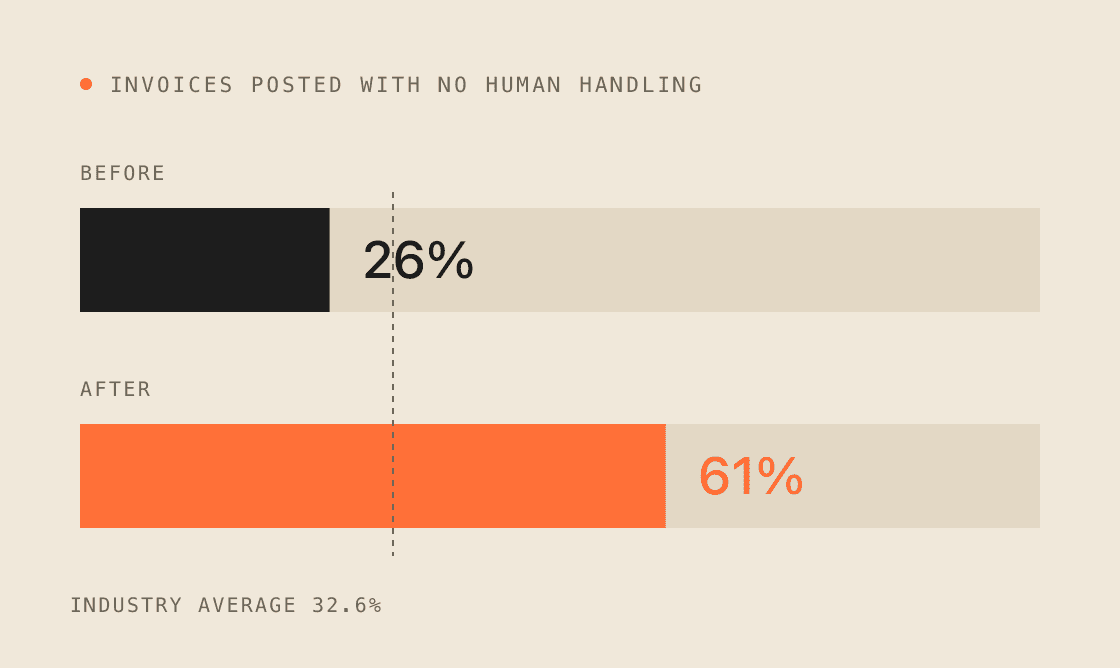
Invoices posted without human handling | 26% | 61% |
Operating cost removed, annualised | — | $597,000 – $652,000 |
The Situation
The client was a LMM PE firm with approx $1.3Bn deployed across 9 portcos on approx $690Mn of aggregate revenue.
Finance headcount totalled to approx 48. 45 across the companies and 3-4 at the firm. The portcos process 218,000 invoices a year against $302Mn of non payroll spend.
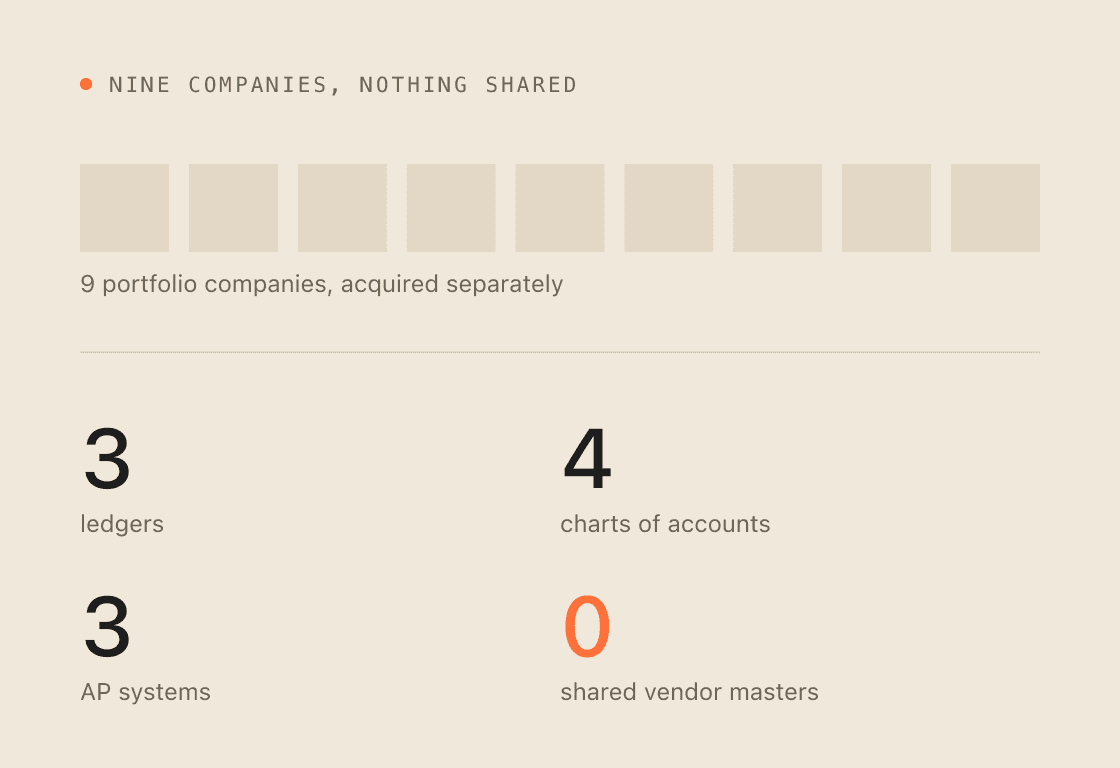
The companies did not share a common platform, and were acquired separately. Between them, they ran 3 accounting platforms, four charts of accounts and 3 AP systems, with no shared vendor master.
Each company's close ran anywhere between 12-14 business days. The portco roll-up would reach the operating partner around Day 18, by which the largest companies would have already started the following month's close.
Reviewing 14 closed months, we found ~260 unresolved matching breaks open at each company, at close. And cross system reconciliation relied on a person understanding the rules and exceptions.
Additionally, the firm had already priced the obvious solution of trying to standardise all nine companies onto one master accounting platform. They were given a 7 figure quote, on a 15-18 month timeline.
The companies already owned payables automation platforms. But given the complexity and specific vendor nuances, the portcos still posted only 26% of invoices without human handling, against an industry avg of 32.6 percent. Almost 80% of repeatable exceptions could be categorised under 12 broad categories.
Our Approach
We ran a 6 week diagnostic, which was a combination of lengthy interviews, drawing out process diagrams and understanding how controllers and accounts payable staff operated. We focused on three companies with the longest closes first, and shadowed the month end close process.
14 months of transaction history was extracted from all 9 ledgers to establish a baseline which was approved by the firm's controller.
We uncovered three operating rules, and a dozen off hand rules that appeared that were previously undocumented. Two companies applied a different accrual method in the fourth quarter. A system approval threshold recorded $100K where the operative threshold was $50K, with the CFO having overridden it manually for two years.
We set out to build for the next 8 weeks, ensuring no system was replaced or charts of accounts got merged. The operating layer connects each company's existing ledger and payables platform through their own interfaces.
The Finance Operator Layer had five workstreams, along with separate views for the CFO, controller and the accounts team.
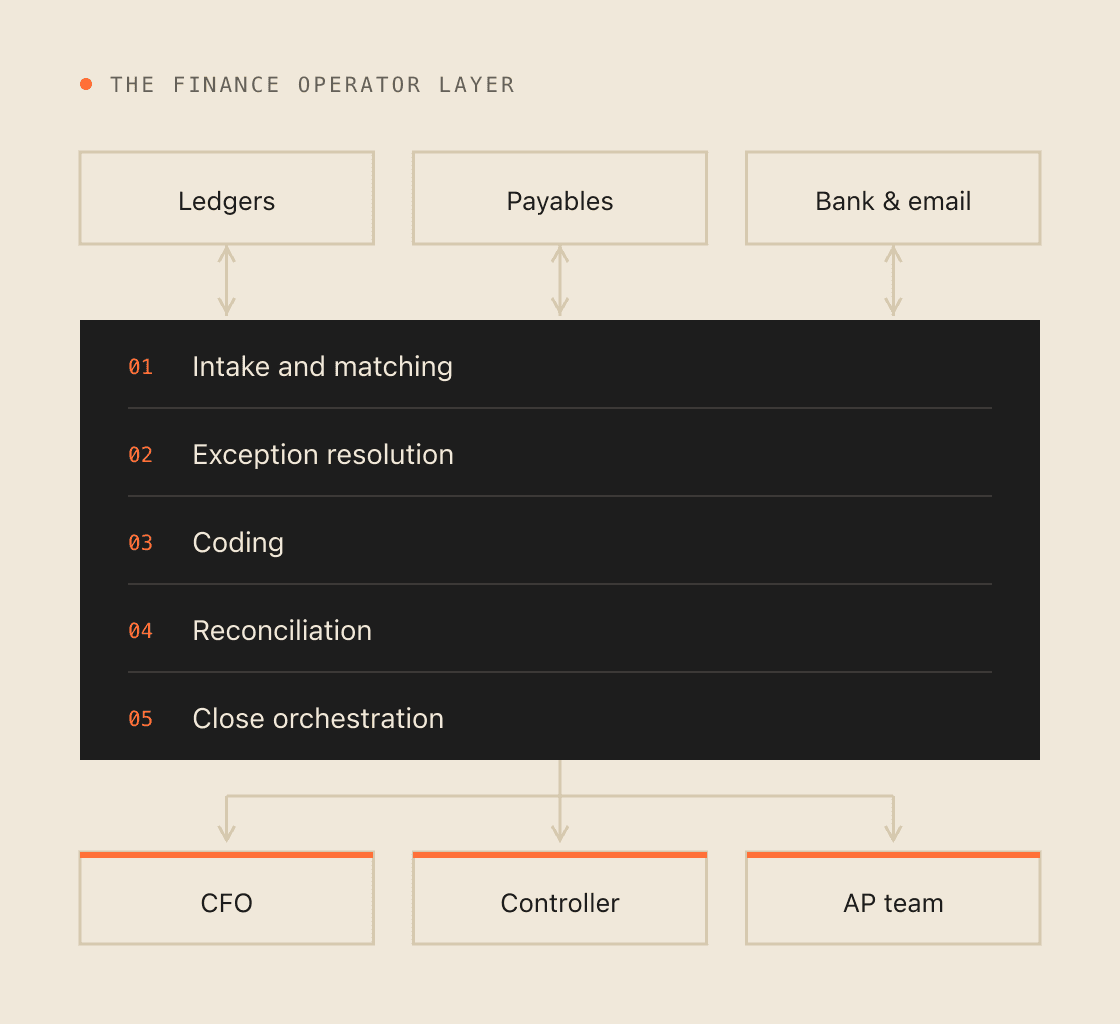
Intake and Matching. Invoices were collected from emails, vendor portals and payables inboxes, and subsequently matched against the purchase order and receiving record.
Exception Resolution. Every break was classified against the twelve recurring types and only cleared if it falls inside the company's allowed tolerance. Anything else gets routed and escalated to the right person, with the rule in contention and evidence assembled.
Coding. Every company retains its own chart of accounts and coding rules, which are encoded and enforced separately. Each posting has an audit trail, carrying the rule that produced it.
Reconciliation. Bank, subledger and intercompany balances are compared daily, as opposed to doing it around the close.
Close Orchestration. Every close task across the nine companies gets tracked in a single view.
Approx 70% of the system's operations are deterministic. Amounts, any tolerances, tax treatment and approval thresholds are calculated in code. LLMs read docs and classify exceptions, but are never asked to compute a figure.
Governance
The system had four guiding principles from the start, and they remained unchanged.
Payment release remains a human action and will remain inside a company's payable platform. The system will never hold any banking credentials.
The system will never amend a vendor record. It only assembles the request and routes it to a person on a verified callback path.
Every action is recorded with inputs, relevant rule and the model version that produced it alongside the approver, where one was required. Postings can be reversed with a linked reason code.
The external auditors were briefed in month two and there were two controls that were re-classified as IT dependent.
The Results
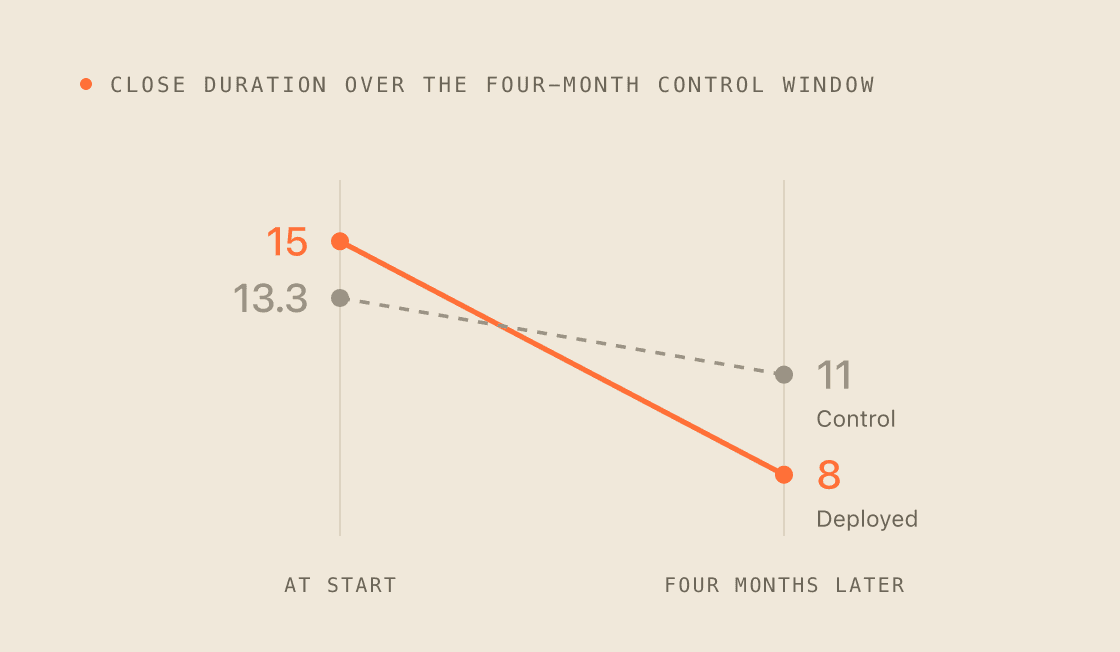
It was a phased rollout. Companies 1-3 by month 4, and the remaining spread across the next 2 months. The later companies ended up being a control group for four months.
And during this time period, their close duration moved from 13.3 days to 11, while the first three moved from 15 days to 8.
Measure | Before | After |
|---|---|---|
Close duration per company | 13.0 days | 8.0 days |
Consolidated numbers to the firm | day 15–20 | day 8 |
Invoices posted without human handling | 26% | 61% |
Invoices requiring human investigation | 12.4% | 1.6% |
Open matching breaks at close, per company | 260 | 38 |
Coding agreement with the controller | 87% | 97% |
Intercompany differences found at audit | 3.6% | 0.4% |
New acquisition into portfolio reporting | 3–6 months | 3–5 weeks |
Moving reconciliations automatically shortened the close. Breaks previously found on the third day of close were resolved in the same month they arose.
The firm also hired a controller, and one of the companies upgraded its accounting platform in month 6.
The economics
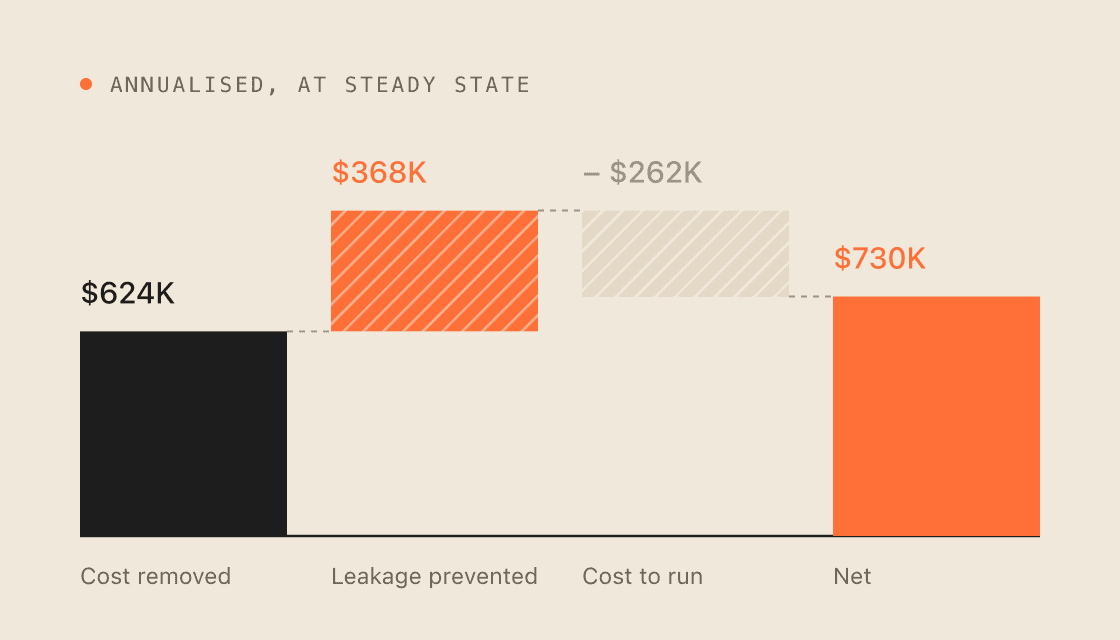
Operating cost removed: $597,000 to $652,000 a year
Each line was reconciled by the firm's Controller against the approved headcount plan.
Annualised | |
|---|---|
Finance requisitions not filled, 4 of 4 approved | $320,000 – $348,000 |
Integration hires not made, two acquisitions | $277,000 – $304,000 |
Total | $597,000 – $652,000 |
Payment leakage prevented: $310,000 to $425,000 a year
Annualised | |
|---|---|
Price and quantity variance stopped before payment | $225,000 – $305,000 |
Duplicate and erroneous payments prevented | $85,000 – $120,000 |
Total | $310,000 – $425,000 |
Variance was itemised by invoice and discounted at 46 percent, the share the finance team historically recovered later through credit notes.
Cost to run: $262,000 a year
Includes infrastructure inside the firm's own cloud tenancy, model usage, evidence storage and retained engineering for rule changes.
That is roughly $29,000 per portfolio company a year, or $1.20 an invoice. Net of the cost to run it, the engagement returns $645,000 to $815,000 a year.
A caveat. The first-year figures are lower than the annualised ones, as the last three companies went live in month six.
Around 30K hours a year were released and re-deployed for better strategic activities. Which include vendor management, portco reporting and acquisition integration. And this number was not given a dollar value.
Where this applies
The engagement suits portfolios of six or more companies, each above roughly 500 invoices a month.
Most exceptions can be categorised and pattern matched. All we need is a named exec to own the outcome.
Companies mid-migration or mid-acquisition can avoid extensive DB migration costs by deploying these "systems of action", which dramatically accelerates timelines and reduces costs.
Holding companies that deal with inter-country and inter-continental transactions that need to get centralised at both the country HQ and the main HQ.
PE firms looking to standardise accounting processes, to accelerate monthly close and acquire more platform companies aggressively without a proportionate increase in headcount.
Read also